1. The Short Answer: What Makes a Homestay Near Kullu the Perfect Natural Escape?
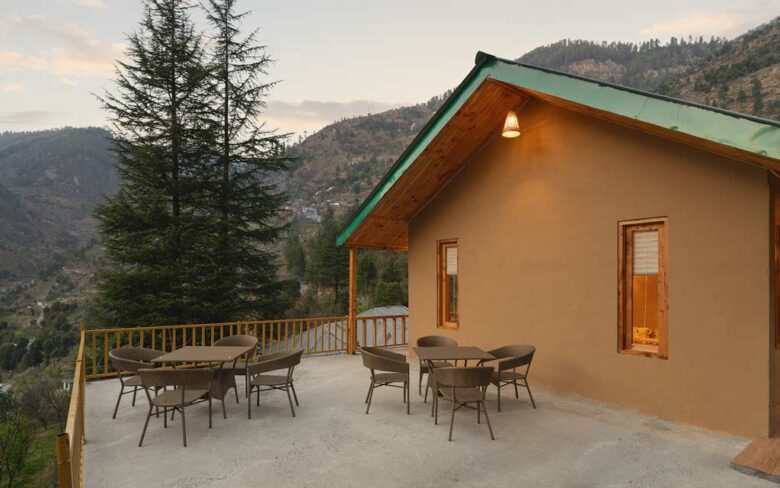
If you’re looking for a homestay near Kullu that goes beyond just a bed and a mountain view, Deotha village in the Sainj Valley is where genuine rest begins. Nestled between ancient deodar forests, this pocket of Himachal Pradesh offers something that five-star resorts in crowded hill stations simply cannot complete stillness. Instead of traffic noise, tourist crowds, and busy schedules, you’ll find peace, fresh mountain air, and a slower pace of life. As a result, you can truly unwind and reconnect with nature without any distractions.
A natural retreat in this region means waking up to the sound of a stream, drinking chai on a wooden balcony while clouds drift below you, and going to bed when the stars tell you to. It’s the kind of reset that takes days to properly sink in, and that’s exactly the point.
The village of Deotha sits at approximately 7,200 feet above sea level and is located close to Jibhi, one of Himachal Pradesh’s most beloved offbeat destinations. As a result, it offers visitors breathtaking mountain views and a peaceful retreat from crowded tourist spots. If you’ve been hunting for the best stay near Jibhi, this is where the search ends.
2. Where Is Deotha and Why It’s Becoming Himachal’s Best-Kept Secret
Deotha isn’t on every travel map yet. That’s what makes it special, and that window won’t stay open forever.
Located in the Tirthan-Sainj corridor of the Kullu district, Deotha is roughly a 5–6 hour drive from Chandigarh and about 18 km from Jibhi. The Great Himalayan National Park (GHNP), a UNESCO World Heritage Site, sits right at its doorstep. The biodiversity here is extraordinary, snow leopards, Western Tragopan, brown bears, and over 375 bird species have been documented in this protected zone.
For the wellness traveller, this geography matters. Research from environmental psychology consistently shows that spending time in biodiverse natural settings, forests, rivers, high-altitude meadows, meaningfully reduces cortisol (the stress hormone) and improves emotional regulation. Deotha gives you all three simultaneously.
The village itself has a quiet, lived-in quality that package-tour destinations rarely offer. Local families still practice age-old traditions, Nati folk dances during festivals, wood-carving passed down through generations, and organic farming methods untouched by industrialization. Staying here isn’t visiting a postcard; it’s stepping into a living, breathing community.
For travellers searching for a Jibhi near homestay that connects them authentically to Himachali culture and landscape, Deotha is genuinely unmatched.
3. What a True Natural Retreat Near Jibhi Actually Looks Like
Let’s be honest, “natural retreat” has become a heavily marketed phrase. It gets attached to everything from a hotel with a swimming pool to a mountain lodge with a yoga mat in the corner.
A real natural retreat near Jibhi is defined by a specific quality of environment, intentionality, and experience. Here’s what that actually looks like.
Forest Bathing and Shinrin-Yoku Principles
The Japanese practice of Shinrin-yoku (forest bathing) isn’t a metaphor, it’s a medically studied activity. Phytoncides (organic compounds released by trees, especially conifers like deodar and pine) have been shown in peer-reviewed studies to lower blood pressure, improve sleep quality, and boost NK (natural killer) cell activity in the immune system.
The deodar forests surrounding Deotha are dense and old-growth, meaning phytoncide concentrations are high. Simply walking through these paths, breathing slowly, counts as treatment in Japan’s formal healthcare system. Here, it’s your daily morning walk.
Digital Detox by Natural Default
One of the biggest barriers to genuine natural is the smartphone. Himalayan villages at altitude naturally have patchy or absent mobile data networks. What feels like an inconvenience for the first few hours becomes one of the most liberating aspects of the stay by Day 2. The brain begins to decompress. Attention spans rebuild. Sleep depth improves. This isn’t a manufactured “digital detox programme”, it’s geography doing what no app can.
Yoga and Meditation in Their Natural Habitat
Yoga was designed for exactly the kind of environment Deotha offers, mountain air, stillness, natural light, unhurried mornings. Practising on a terrace overlooking forested slopes and a river valley transforms what might be a 20-minute home-routine into something much more profound. Many guests report that even basic pranayama (breathwork) feels physically different at altitude, because it genuinely is, the oxygen dynamics change, encouraging slower, deeper breathing by default.
Sleep Restoration at High Altitude
Urban sleep is often fragmented, light pollution, noise, irregular temperatures, screen exposure. In Deotha, darkness is complete after sunset. Temperatures drop to naturally sleep-inducing levels by evening. Birdsong (not an alarm clock) initiates your morning. Within 2–3 nights, most visitors report the deepest, most uninterrupted sleep they’ve had in months.
4. Luxury Rooms Near Jibhi: What to Expect at a Premium Himalayan Stay
There’s a persistent misconception that luxury and remote Himalayan settings are mutually exclusive. They’re not, and the best homestays in this region prove it every season.
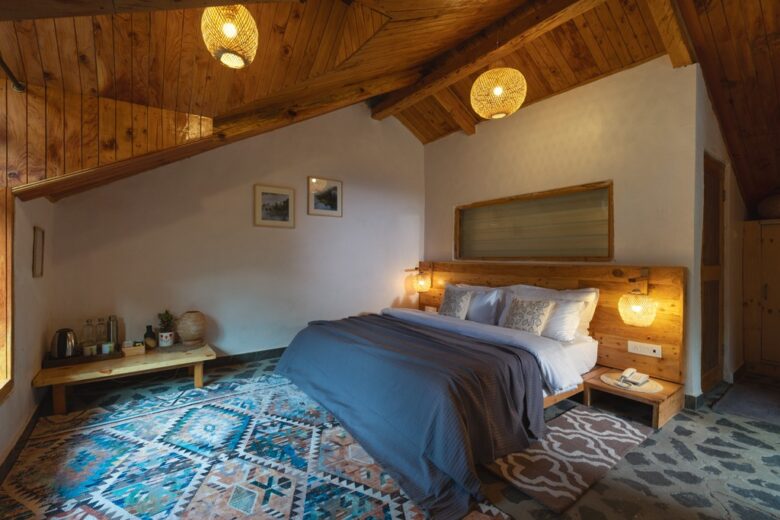
When people search for luxury accommodation near Jibhi or a luxury room near Jibhi, what they’re really looking for is this: comfort that doesn’t compromise the experience of where you actually are.
Architecture That Honors the Landscape
Traditional Himachali architecture uses local stone, deodar wood, slate roofing, and layered wooden balconies called kothis. The best luxury stays in this region follow this aesthetic rather than importing urban hotel aesthetics. The result is spaces that feel both comfortable and authentic, high ceilings, warm wooden interiors, fireplaces or bukhari stoves for winter, and wide windows that frame mountains rather than obstruct them.
Room Features Worth Caring About
A well-appointed luxury room near Jibhi should offer:
- Beds with high-quality linen suited for mountain temperatures (cold nights even in summer)
- Attached bathrooms with reliable hot water, non-negotiable at altitude
- Sufficient blankets and duvets for sub-zero winter nights
- Heating arrangements (bukhari, electric heater, or both)
- A private sit-out or balcony with unobstructed views
- Reading lighting that doesn’t force you into harsh fluorescent light
What “Luxury” Really Means Here
In this context, the ultimate luxury is space, from crowds, from urgency, from noise. A wood-fired breakfast. A blanket on the balcony with a book. A host who tells you which trail is blooming right now. These are the details that distinguish a best homestay near Jibhi from simply a place to sleep.
5. Activities That Heal: Mind, Body, and Soul Experiences
A natural retreat near Kullu should offer more than passive rest, it should give you things to do that restore you at different levels.
Trekking Into the GHNP Buffer Zone
The Great Himalayan National Park’s buffer zone, accessible from Deotha, has trails through rhododendron forests, alpine meadows (bugyal), and alongside the Tirthan River. Distances range from easy 2-hour walks to full-day treks reaching Rolla and beyond. Every trail offers the dual benefit of physical exertion and sensory immersion in a pristine landscape.
Fishing on the Tirthan River
The Tirthan River, classified as a protected waterway within GHNP, is one of the few rivers in India where wild trout (Brown and Rainbow) still thrive. Fishing here requires a permit from the Forest Department, and catch-and-release practices are standard. The act of standing in cold, clear mountain water, watching it move, requires a presence and patience that is inherently meditative.
Village Walks and Cultural Immersion
Deotha and its neighbouring villages, Nagini, Rolla, Gushaini, are worth exploring on foot. Stone-paved paths between terraced farms, ancient temples with intricate woodcarving, and conversations with locals who speak warmly of their valley. These experiences don’t require a guide, they just require slowing down enough to notice.
Stargazing at High Altitude
At Deotha’s elevation and with minimal light pollution, the night sky in clear conditions is genuinely spectacular. The Milky Way is visible to the naked eye on dark moon nights. In autumn and winter, meteor showers like the Perseids and Geminids are dramatic here. No telescope needed, just a clear night and a blanket.
6. The Food That Restores You: Farm-to-Table Himalayan Cuisine
natural and nutrition are inseparable. The food tradition of Himachal Pradesh is one of India’s most underappreciated culinary legacies, and it happens to be exactly what a natural-focused body needs.
What Himachali Food Actually Is
The base of Himachali home cooking is grain, legume, and local vegetable-forward. Siddu (stuffed steamed bread), Dham (a festive multi-course meal served on leaf plates), Madra (slow-cooked chickpeas in yogurt gravy), Babru (fried kachori with black gram filling), and Aktori (buckwheat pancakes) form the traditional repertoire.
These aren’t marketing buzzwords, they are genuinely nutritious preparations that have sustained mountain communities through harsh winters for centuries. High in complex carbohydrates, fibre, and plant-based protein, and low in processed ingredients.
Locally Sourced, Genuinely Seasonal
Depending on the season, a homestay kitchen in Deotha will draw from its own or a neighbour’s garden, fresh fenugreek (methi), mustard greens (sarson), radishes, potatoes, and seasonal herbs. In summer, wild foods, lingri (fiddle-head fern), bhang chutney (hemp seed), and wild mushrooms, appear in meals.
The honey produced in this valley, primarily from Himalayan stingless bees, is genuinely exceptional: darker, richer, and more nutritionally complex than the commercial varieties. A jar of it is worth taking home.
7. Seasonal Guide: When to Visit for Your Best Experience
Every season in Deotha offers something distinct. Your natural needs might align with one more than others.
Spring (March – June): Bloom and Renewal
Rhododendrons turn the hillsides crimson and pink. Temperatures are mild (12–22°C in the day), trails are open, and the valley is waking up. Ideal for trekking, birdwatching (migratory species return), and long exploratory days. Apple orchards begin to blossom, filling the air with a scent that no perfume house has successfully replicated.
Monsoon (July – September): Green Intensity
The rains transform the valley into something almost surreally green. Waterfalls appear on every hillside. The Tirthan runs fast and loud. Trekking becomes more challenging (and more dramatic). The upside: this is the quietest time for tourism, meaning the most intimate experience for those comfortable with rain.
Autumn (October – November): The Pinnacle Season
Widely regarded as the best time to visit this region. Clear skies, warm days (15–22°C), cold nights, golden foliage. The GHNP trails are at their most rewarding. Wildlife is more active before winter. Apple harvest season fills every kitchen with fruit. If you can only come once, come in October.
Winter (December – February): Deep Quiet
Snow transforms Deotha into a white silence. Not all homestays operate through peak winter, but those that do offer something extraordinary, the valley at its most elemental, nights of absolute stillness, and the chance to experience Himachali winter traditions. A bukhari (wood-fired stove) and a good book make this unforgettable.
8. How to Reach the Best Homestay Near Jibhi
Reaching Deotha requires intention, which is, in itself, part of the experience.
From Chandigarh (approx. 5–6 hours): Take NH-21 (Chandigarh–Manali highway) to Aut Tunnel, then turn onto the Banjar–Jibhi road. From Jibhi, Deotha is approximately 12 km further into the Sainj Valley. The road is navigable in a regular car in summer and autumn. A 4WD is advisable for winter visits.
From Delhi (approx. 10–12 hours): Overnight bus/volvo to Aut or Kullu, then hire a local cab. Alternatively, fly into Bhuntar Airport (Kullu), from where the drive is 2–2.5 hours.
From Manali (approx. 3–4 hours): Head south on NH-21 to Aut, then follow the Banjar road.
The nearest town for supplies is Banjar (12–15 km). Taxis from Jibhi to Deotha cost approximately ₹300–500 depending on the vehicle and negotiation.
Conclusion
If you’ve been holding on to the idea of a trip that genuinely restores you, not just a holiday that adds more photos to a camera roll, but a stay that leaves you sleeping better, thinking more clearly, and breathing easier, then Deotha is where that trip happens.
Bhigasa is built for exactly this. Rooted in the landscape of Deotha village, thoughtfully designed to offer both authentic Himachali warmth and the comforts that matter at altitude, Bhigasa is more than accommodation, it’s the base from which you rediscover what quiet actually sounds like.
Whether you’re searching for a homestay near Kullu, the best homestay near Jibhi, luxury accommodation near Jibhi, or simply a place where the mountains do most of the talking, Bhigasa is ready when you are.
Visit bhigasa.in to check availability and book your natural escape.
Frequently Asked Questions
Q1: What type of accommodation is available for a natural retreat near Jibhi?
Bhigasa in Deotha village offers thoughtfully designed luxury rooms near Jibhi that combine traditional Himachali architecture with modern comforts, private balconies, hot water, premium bedding, and panoramic mountain views. It’s the ideal luxury accommodation near Jibhi for a genuine natural experience, not just a mountain stopover.
Q2: How far is the homestay from Jibhi, and is it easy to reach?
Bhigasa is located in Deotha, approximately 18 km from Jibhi via the Sainj Valley road. The drive itself is scenic and accessible by regular car through spring, summer, and autumn. As one of the best homestays near Jibhi, Bhigasa makes the journey easy, detailed directions and local taxi contacts are provided at booking.
Q3: What wellness activities are available during a stay?
Guests at this natural retreat near Jibhi have access to guided forest walks, self-guided trails into the GHNP buffer zone, yoga-friendly spaces with open mountain views, fishing on the Tirthan River, village exploration, and stargazing on clear nights. Bhigasa’s environment itself is the primary wellness offering, it’s designed for deep rest, not curated programming.
Q4: Is this a good place for a solo natural retreat near Kullu?
Absolutely. Bhigasa is particularly well-suited for solo travellers seeking a homestay near Kullu for introspection and renewal. The peaceful setting, warm host family, and safe environment make solo stays both comfortable and deeply restorative. Many guests find that solo time in this valley is the most productive “thinking time” they’ve experienced.
Q5: What food is served, and can dietary requirements be accommodated?
Bhigasa serves home-cooked Himachali meals using local and seasonal ingredients, a genuine farm-to-table experience that forms a core part of the wellness stay. Vegetarian, vegan, and gluten-aware options can be accommodated with advance notice. This is one of the many reasons Bhigasa stands out as the best stay near Jibhi for health-conscious travellers.
Q6: Can I extend my stay if I want to spend more time at the retreat?
Yes, Bhigasa welcomes extended stays, and many guests do choose to extend once they arrive. The valley has enough to keep even a curious mind occupied for 7–10 days without repetition. Whether you want a 2-night reset or a 10-day deep retreat, Bhigasa as a Jibhi near homestay can accommodate your needs with advance booking.