There’s a particular kind of vacation that’s hard to plan because it doesn’t really fit into a standard booking filter. You’re not after a hotel with a gym and a pool. You’re also not looking for a sleeping bag on a plywood bed. What you actually want is a well-made room with a good view, food that tastes like someone cooked it rather than reheated it, and enough quiet to remember what rest feels like.
That’s the gap that a really good hotel room near Tirthan Valley fills, and it’s also the gap that most searches on the subject fail to answer properly. So this is a guide that tries to do it honestly: what makes a room worth booking in this corner of Himachal Pradesh, where the best options actually are, what “premium” means at this altitude, and how to book the right stay for your specific kind of trip.
Tirthan Valley itself needs no grand introduction to anyone who’s done even a bit of searching. It’s a forested river valley in the Kullu district of Himachal Pradesh, tucked between the Tirthan River and the edge of the Great Himalayan National Park (GHNP), a UNESCO World Heritage Site. What makes it different from Manali or Kasol is the pace and the quiet. There are no cable cars, no DJ bars, no shopping malls. Just mountains, forest, cold river water, and the kind of birdsong that gets annoying to describe because every description sounds like a greeting card.
If that’s what you’re after, the next question is simple: where exactly do you stay, and what does the room look like when you get there?
What Travelers Are Actually Looking for When They Search ‘Hotel Room Near Tirthan Valley’
It’s worth naming this because the phrase covers very different things depending on who’s searching it. Someone planning a family vacation of four people has completely different needs from a couple looking for a quiet anniversary trip, which is different again from a solo trekker who just wants a base near the GHNP gate.
Based on what most travelers end up asking for, the main categories shake out like this:
Families Looking to Book a Room Near Tirthan for the First Time
Families typically want two things above everything else: space and safety. A narrow room with a single mattress crammed against the wall doesn’t work. Neither does a balcony with a broken railing or a staircase that a five-year-old can tumble down in the dark. For families, the ideal hotel room near Tirthan Valley is spacious, ground-floor accessible at least partly, and in a property small enough that the kids can wander around the garden without disappearing into a crowd.
Meals matter too. Families with children rarely want to hunt for a restaurant after a long drive through the mountains. They want something reliable, freshly made, and available at a reasonable dinner hour, not just when the cook feels like it.
Couples and Honeymooners Wanting a Mountain View Room
For couples, the room itself becomes the experience rather than just a place to sleep. A private balcony facing the forested hillside, a proper king bed, a morning that starts with mist rising off the canopy rather than an alarm from the room next door, that’s the brief. A mountain view room near Tirthan Valley delivers this only if the property has actually thought about positioning: which direction the rooms face, how much privacy a balcony actually gives, and whether the view is genuinely towards the ridge or just towards another row of rooms.
Extended-Stay Guests Who Want a Premium Room Without Driving to Manali
A growing category: travelers who want to stay five to seven nights in one place and actually decompress, rather than hop between towns with a heavy bag. For this group, premium rooms near Tirthan need to offer enough comfort to be liveable for a week, good wifi, warm water, a proper desk or table, and meals that don’t get boring by day three. The location needs to be quiet without being inaccessible.
What Makes a ‘Best Hotel Room’ Near Tirthan Valley, and What You’re Usually Not Told
Most booking platforms tell you what a room has (AC, TV, king bed) without telling you what it actually feels like. Here’s what actually separates the best hotel rooms near Tirthan Valley from the average ones:
| Factor | Average Room | A Genuinely Good Room |
| Size | Under 200 sq ft, furniture feels crammed | 250–350 sq ft with room to breathe |
| View | Faces a wall, corridor, or another room | Private balcony or window facing forest / mountain |
| Meals | Restaurant menu, generic items, extra cost | Home-cooked, included, made with local produce |
| Noise | Shared walls, road traffic audible | Set back from main road, natural sound buffer |
| Personalisation | Mass-hotel service, generic check-in | Host-run, personal, small number of rooms |
| Bathroom | Functional but bare | Clean, hot water on demand, well-lit |
| Network | No wifi promised; disappoints on arrival | Mountain wifi available; limitations stated upfront |
The short version: the best hotel room near Tirthan Valley is the one where the experience matches what was described when you booked it. That sounds obvious, but it’s genuinely rare, and it’s the clearest reason to look at smaller, host-led properties rather than listings aggregated from a generic OTA database.
Premium Rooms Near Tirthan: What ‘Premium’ Actually Means at This Altitude
Let’s be clear about something: premium rooms near Tirthan Valley are not premium in the way a five-star business hotel in Mumbai is premium. There’s no concierge with a earpiece, no turndown service with chocolates on the pillow, no heated pool.
What premium means here is more honest and, in some ways, harder to actually deliver:
- A room built with care, not just built to fill a space. Good light. A bed that’s actually comfortable. Windows that open onto something worth looking at.
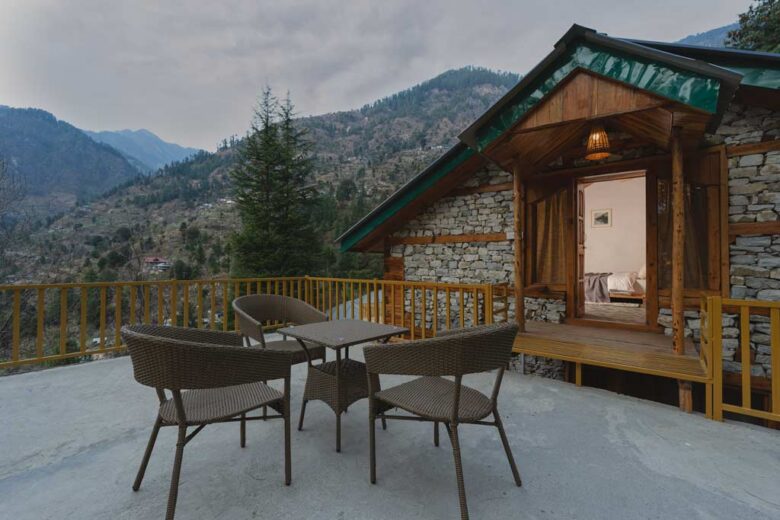
- Privacy that holds. A private sit-out or balcony where you’re not sharing views or conversations with the room next door.
- Food that’s made to a standard. Not a restaurant standard, a home standard. Which is actually higher, when it’s done well.
- A host who knows the valley, where to walk, what to avoid in monsoon, which trail has the best birdsong at 6am, whether the road to Jalori Pass is open this week.
- No surprises at checkout. Everything that costs extra should be named upfront.
That’s the benchmark for premium rooms near Tirthan. It’s an experiential definition, not a facilities checklist.
Mountain View Room Tirthan Valley: Where to Actually Find One Worth Booking
A mountain view room near Tirthan Valley is worth seeking out deliberately rather than just hoping for in the booking notes. The valley’s geography means that not every property has rooms oriented toward the ridgelines, many face the river, some face the road, and some face nothing particularly interesting at all.
The villages that tend to give you the best natural positioning for mountain and forest views are the ones set slightly above the main road and facing north or northeast into the forest-covered slopes. Deotha, the small village above Jibhi where BhigaSa is located, sits in exactly this kind of position, dense pine and oak forest on three sides, with morning mist settling into the canopy before the sun burns it off by mid-morning.
When evaluating a mountain view room, ask specifically:
- Does the room face the ridgeline or the road?
- Is there a private balcony, or a shared veranda where the view is interrupted by other guests?
- What time does the sun hit the balcony? (South-facing rooms get afternoon sun; north-facing get the best forest light in mornings)
- Are there any construction projects nearby that block the view? A common issue in recently developed parts of Jibhi.
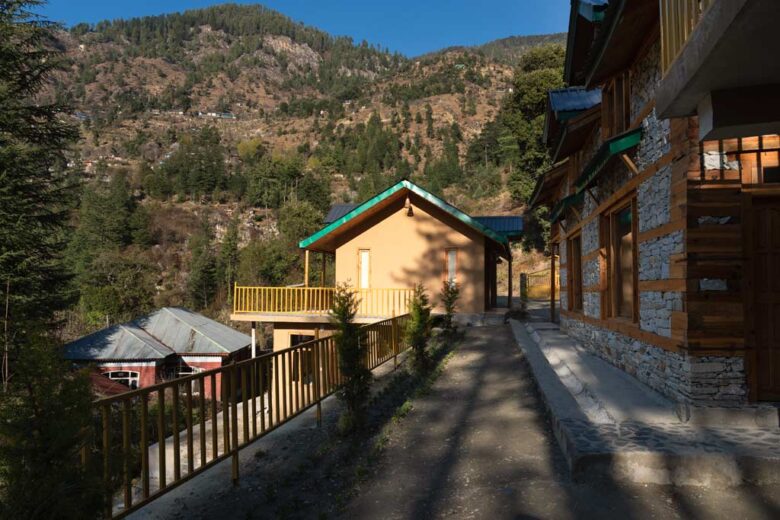
At BhigaSa, both Parvat and Baadal, the first-floor rooms, offer private balconies or sit-out decks facing the tree canopy and hill slopes. Even the ground-floor rooms, Barkha and Tarang, have large windows and private seating areas that open directly into the surrounding jungle rather than onto a shared patio.
BhigaSa, The Best Hotel Room Near Tirthan Valley That Isn’t Technically a Hotel
BhigaSa is a four-room boutique luxury homestay in Deotha village, Banjar tehsil, Kullu, roughly a 35 to 45-minute drive from the GHNP gateway village of Gushaini, a short drive from Jibhi’s waterfall and cafés, and well off the main road that most Tirthan-bound vehicles follow. It doesn’t appear on most generic hotel aggregators, which is partly what keeps it quiet.
The property was designed around a specific idea: that the most memorable stays in the mountains aren’t built on services you can find in a city, they’re built on things you can’t. The silence in the morning. A breakfast made in a proper kitchen and brought to the table while it’s still warm. A room where you can leave the balcony door open at night without a highway two floors below you.
Room Guide: Which Room to Book and Why
| Room | Floor | Signature Feature | Best For |
| Barkha | Ground | Large windows with direct jungle view | First-time visitors who want ease of access |
| Tarang | Ground | Private seating area, forward-facing | Extended stays; natural light all morning |
| Baadal | First | Private sitting deck, canopy-level view | Couples seeking height and privacy |
| Parvat | First | Private balcony, mountain view outlook | Anyone who specifically wants a mountain view room |
Every room at BhigaSa spans 300 sq ft and is thoughtfully designed for two guests. This generous size stands out in a region where a “hotel room” can sometimes be nothing more than a repurposed storage space with a lock on the door. Additionally, every room features a comfortable king-size bed. Rather than focusing on quantity, the property follows the philosophy that offering fewer, well-designed rooms creates a more personalized experience, ensuring guests feel valued instead of being treated as just another room number.
Meals: The Part Guests Usually Remember Most
Home-cooked Himachali meals made with local produce come included with your stay. Instead of relying on a restaurant attached to the property, the hosts prepare authentic meals using traditional recipes and fresh local ingredients. They serve every meal at a relaxed pace that matches the peaceful mountain setting rather than the rush of a busy dining room. Slow mornings begin with a wholesome breakfast, making it a natural part of the experience.
What BhigaSa Offers as a Complete Stay
| What You Get | Detail |
| Room Size | 300 sq ft per room, spacious by valley standards |
| Beds | King bed in all four rooms |
| Private Outdoor Space | Private balcony, deck, or sit-out (all rooms) |
| View | Forest canopy and mountain ridge facing rooms |
| Meals | Home-cooked Himachali cuisine, local produce |
| Wifi | Available, honest about mountain connectivity |
| Activities Nearby | GHNP treks, Jibhi waterfall, Chehni Kothi, river walks |
| Setting | Deotha village, off the main road, within forest |
| Capacity | 4 rooms, 2 guests each, max 8 guests at any time |
| Contact / Booking | +91 98776 29443 | hello@bhigasa.in | bhigasa.in |
Booking a Room Near Tirthan Valley for a Family: A Practical Checklist
If you’re planning a family vacation to the Tirthan area, the following checklist will help you avoid the most common booking mistakes:
Before You Book
- Confirm the number of rooms needed, most boutique properties in this area are designed for 2 guests per room
- Ask specifically if ground-floor rooms are available (important for families with elderly members or very young children)
- Check whether meals are included or separately charged, hidden meal costs can add up fast over a 4-night family stay
- Verify road accessibility, some Tirthan Valley properties require a short uphill walk with luggage after the car stops
- Ask about the host’s knowledge of child-friendly activities nearby, a good host will know exactly what works for different ages
What Makes the Tirthan Valley Area Family-Friendly
- No heavy traffic or congested tourist zones in the quieter villages like Deotha and Jibhi
- Safe, short forest walks accessible without any specialist gear
- River-side exploration and light trout-fishing experiences suitable for older children
- Clean air, open spaces, and a pace of life that works well for kids who’ve been confined to screen-time and city apartments
- Accommodation that feels like a home rather than a hotel, important for children who struggle with unfamiliar environments
When to Book Your Hotel Room Near Tirthan Valley
| Season | Months | What It’s Like | Booking Lead Time |
| Spring | Mar–Jun | Warm days, blooming orchards, clear skies, peak crowds | 4–6 weeks minimum |
| Monsoon | Jul–Aug | Deep green valley, rain, possible road disruptions | 2–3 weeks (availability is higher) |
| Autumn | Sep–Nov | Crisp air, golden light, great for treks and photography | 4–6 weeks minimum |
| Winter | Dec–Feb | Cold, quiet, snow possible; perfect for a fireside retreat | 1–2 weeks typically fine |
The honest advice: if you have any flexibility, September through mid-November is one of the best-kept secrets in the Tirthan calendar. The summer crowds are gone, the air is sharp and clear, the light is golden in the early evenings, and the apple orchards are heavy with fruit. You’ll find the best hotel rooms near Tirthan Valley more available, and often a little quieter in price, than in the May–June peak.
What to Do Near Your Room: Building a Tirthan Valley Itinerary
One of the more common regrets from Tirthan Valley first-timers is not giving themselves enough time. The valley rewards slowness, but it also has enough to fill a week if you want it to. Here’s a rough guide to pacing your stay from a base like Deotha:
Day 1: Arrive and Settle
Don’t try to pack in sightseeing on arrival day, especially after a long drive. Check in, eat a proper meal, take a short walk into the immediate surroundings. The forest around Deotha reveals itself on foot better than from any viewpoint article.
Day 2: Jibhi and the Waterfall
The Jibhi waterfall hike takes 30–45 minutes through dense oak and rhododendron forest and doesn’t require any specialist gear. Go in the morning before the day-trippers arrive. Stop for tea in Jibhi village on the way back.
Day 3: Chehni Kothi and the Temple Trek
Chehni Kothi is a centuries-old stone and timber fortified tower near Banjar, believed to be around 350 years old and one of the tallest traditional structures of its kind in Himachal. The walk up offers wide valley views. Plan a half-day for this one.
Day 4: GHNP Entry or Trout Fishing
If trekking into the Great Himalayan National Park is on the agenda, day 4 is a good day to do it, your legs are stretched from the earlier walks and you’ve adjusted to the altitude. Even a short entry from Gushaini into the GHNP buffer zone gives you a sense of how wild the landscape gets. Alternatively, arrange a trout fishing session on the Tirthan, one of the few rivers in the western Himalayas where trout fishing is still genuinely viable.
Day 5: Jalori Pass or a Rest Day
If road conditions allow, the drive up to Jalori Pass (at around 3,120 metres) takes less than two hours from Deotha and offers panoramic views across the Seraj region. Alternatively, and just as legitimate, spend day 5 doing very little. Read in the balcony. Watch the mist burn off the canopy. That’s what the room is for.
How to Reach the Tirthan Valley Region and BhigaSa in Deotha
Getting to the Tirthan area requires a bit of planning, especially if you’re coming from Delhi or Chandigarh for the first time. Here’s a quick breakdown:
By Air
Bhuntar Airport (Kullu-Manali Airport) is the nearest airport, located around 50 km from Deotha. Under normal traffic conditions, the drive takes approximately 2 hours. After arriving at the airport, you can hire a local taxi for a direct transfer to Deotha. However, keep in mind that ride-hailing services like Ola and Uber are not reliably available in this remote hilly region.
By Road from Delhi
The standard route is Delhi → Chandigarh → Bilaspur → Mandi → Pandoh → Aut → Larji → Banjar → Jibhi → Deotha. Overall, the journey covers around 500 km and typically takes 11–13 hours, depending on traffic along the Chandigarh bypass and the mountain roads after Mandi. If you’re driving, starting early can help you avoid heavy traffic. Alternatively, if you prefer a more relaxed journey, you can take an overnight Volvo bus to Aut and then hire a local taxi to Deotha the following morning. As a result, this option offers a comfortable and convenient travel experience without the stress of a long drive.
By Road from Chandigarh
Around 260 km and 5–6 hours, following NH205 to Mandi and then onto the Aut–Banjar route. A comfortable day drive if you leave by 6am.
Key Navigational Note
When you reach the Aut Tunnel, do not enter it. Instead, take the smaller road to the right of the tunnel entrance, which leads toward Larji and Banjar. Missing this turn is the most common navigation error on this route, and it adds significant distance if you end up going toward Manali instead.
Ready to Book Your Room Near Tirthan Valley?
However, the best hotel room near Tirthan Valley isn’t always the one with the most reviews on the biggest booking platform. It’s the one that fits how you actually travel, and that’s a conversation worth having before you hit the checkout button.
BhigaSa is a small property with four rooms, a big forest, home-cooked food, and a host who knows this part of Himachal better than any booking algorithm ever will. If any part of this guide described the kind of trip you’re trying to plan, it’s worth a look.
Browse rooms and check availability at bhigasa.in/stay, call +91 98776 29443, or write to hello@bhigasa.in, someone who actually knows the view from the balcony will get back to you.
Frequently Asked Questions
Most boutique stays near Tirthan Valley accommodate two guests per room. Families of four usually need to book two rooms unless a larger suite is available. At BhigaSa, each room accommodates two guests comfortably, making two side-by-side rooms an ideal option with private space and forest-view balconies.
A Mountain View room offers views of the ridgeline instead of an internal courtyard or road. In Deotha, that means forest-covered hills, layered mountains, and misty mornings. If you enjoy relaxing on your balcony with scenic Himalayan views, upgrading to a Mountain View room is well worth it.
A premium stay near Tirthan Valley includes spacious rooms, a private balcony, modern comforts, warm hospitality, and fresh home-cooked meals for a relaxing mountain getaway.
For March–June and September–November (the two main peak windows), booking 4–6 weeks ahead is a safe minimum at most boutique properties. Popular homestays and premium stays often fill up faster than large hotels because they only have a handful of rooms. If you’re planning around a long weekend or a national holiday, 8 weeks ahead is a safer target.
Yes, very much so. The valley is safe, the pace is relaxed, and children take naturally to the open green setting, the birdsong, and the river. Activities like short forest walks, fishing, and exploring local villages are accessible even for younger kids. Just make sure your accommodation has a stable ground-floor option if you’re traveling with very young children, and confirm road access quality before driving in.