Jibhi is stunning. The pine forests, the wooden bridges, and that cold clean air that hits you the moment you step out of the car. We get why everyone’s going there.
But here’s the thing nobody tells you before your trip: on a May long weekend, Jibhi’s main stretch can get genuinely crowded. Cars lined up, cafes packed, strangers photobombing your “quiet mountain moment.” It starts to feel less like an escape and more like a hill station with better Instagram aesthetics.
The good news? Drive just 10–15 minutes in any direction from Jibhi, and it’s a completely different world.
We’re talking about villages where the only sound in the morning is a rooster and the wind in the deodar trees. Meadows where you can sit for an hour and not see another tourist. Trails that lead to ancient ruins and sacred lakes that most visitors never even know exist.
This is that guide. Hidden villages that locals actually call home and offbeat spots that even experienced Himachal travelers tend to miss. And if you want to explore all of it without driving back to a busy guesthouse every night, Deotha Village and BhigaSa Homestay are your answer. But more on that later.
Quick Takeaways
- Hidden villages near Jibhi: Deotha, Shoja, Chehni, Lambri, Shakti, Bathad
- Offbeat places near Jibhi: Serolsar Lake trail, Raghupur Fort, Gushaini, Sainj Valley, Chehni Kothi paths, Jalori Pass meadows
- Best time to go: April–June or September–November
- Best base: BhigaSa in Deotha — 5 km from Jibhi, zero crowds
- Most spots are within 5–30 km of Jibhi town
Hidden Villages Near Jibhi
1. Deotha: 18.0 km from Jibhi | Banjar Tehsil, Kullu
Most people drive right past Deotha without realizing it. There’s no big sign, no cluster of cafes, no obvious reason to stop, unless you know what you’re looking for.
What you’re looking for is this: a hillside village where mornings arrive wrapped in mist. Where terraced fields step down the mountain in neat green rows. Where the stone houses have slate roofs worn smooth by decades of monsoon rain. The view from the upper trail, if you’re there at 6 AM while the mist is still thick, is the kind of thing that makes you feel like you accidentally wandered into a painting.
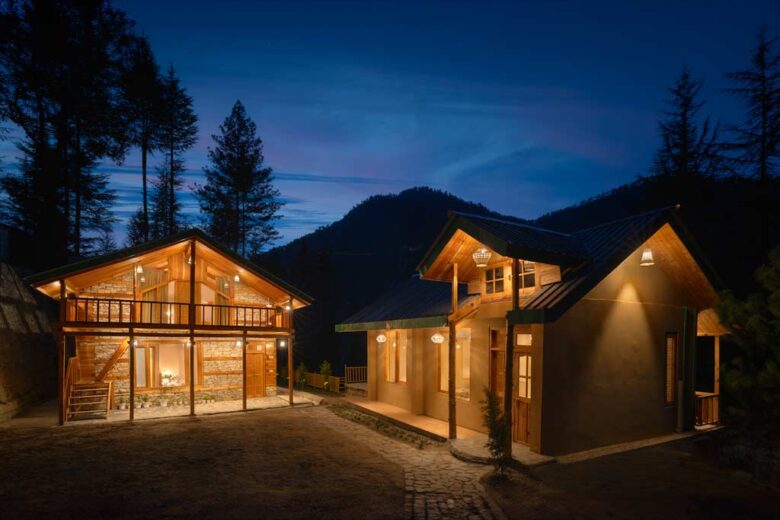
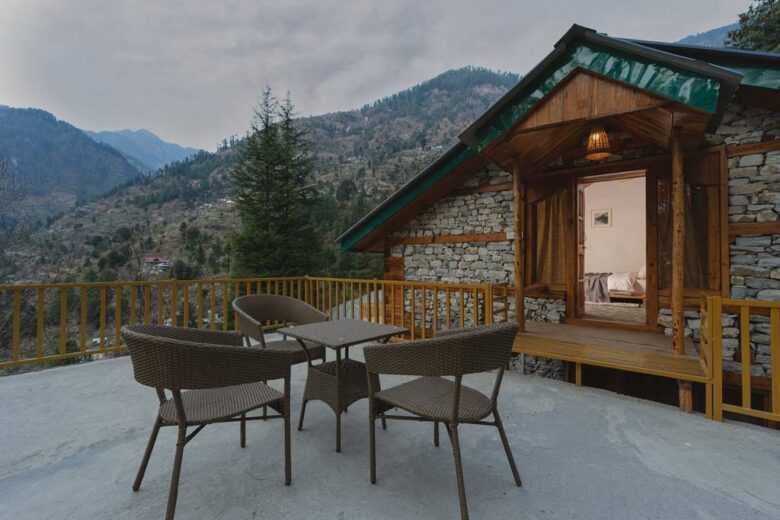
Deotha is also where BhigaSa is a beautiful little luxury homestay sitting right in the middle of the village, with forest views from every room and a quiet that’s hard to describe until you’ve woken up to it. If you’re looking for a base to explore the entire region, this is genuinely it. We’ll circle back with more details.
Who’ll love it: Honestly, everyone. But especially couples, slow travelers, and anyone who’s been to “offbeat” places that turned out to be not that offbeat.
2. Shoja: The Village Most People “Mean To Visit” But Never Do
14 km from Jibhi | Elevation 2,700 m
You’ll hear Shoja mentioned a lot in Jibhi conversations. “We were thinking of going to Shoja.” “Shoja is supposed to be nice.” And then most people don’t go, because it’s just slightly further than a lazy afternoon allows.
Don’t make that mistake.
Shoja sits above Jalori Pass, at a higher elevation than Jibhi, which means even in May the air has a proper cold bite to it. The village is tiny a few guesthouses, meadows on all sides, apple trees, mountain views that hit differently at this height. And just a 45-minute hike above the village are the ruins of Raghupur Fort ancient stone walls sitting above the treeline with 360-degree views of the snow peaks.
On most days, especially on weekday mornings, you’ll have that trail entirely to yourself.
Pro tip: Leave Deotha early, reach Shoja by 7–8 AM before the day-trippers from Jibhi arrive. That early window in the meadow is worth a 5 AM alarm.
Who’ll love it: Couples, photographers, and people who like saying “I found this place before it got popular” and meaning it.
3. Chehni: There’s a 1,500-Year-Old Tower Here and Almost Nobody Visits It
7 km from Jibhi
Chehni Kothi is an ancient multi-story wooden tower that has stood proudly in the village for more than 1,500 years. Built using alternating layers of stone and deodar wood, the structure contains no modern construction materials. Despite facing centuries of harsh Himalayan winters, it remains remarkably strong and intact. Today, it is considered one of the most impressive heritage landmarks in Himachal Pradesh. Surprisingly, many travelers visiting Jibhi are still unaware of this architectural marvel.
The village around it is just as quietly captivating. Stone pathways, small temples, locals going about their day. The kind of place where you show up expecting to spend 20 minutes and end up staying two hours.
Pair it with the Jibhi Waterfall on the same half-day loop; they’re close enough to do together, and the contrast between ancient stone heritage and wild forest waterfall makes for a really satisfying morning.
Who’ll love it: History nerds, architecture fans, anyone who gets excited about things that have survived centuries.
4. Lambri: This One Doesn’t Even Have a Signboard
Between Banjar and Jibhi on a quiet side road
There’s no real pitch for Lambri. It’s just a small, slow, completely unbothered area of tourism, because tourists don’t really go there.
There are no cafés, no guesthouses, and no Instagram geo-tags flooded with thousands of posts. Instead, you’ll find a quiet lane winding through farmland, a nearby river flowing peacefully, and locals continuing traditions that have shaped life in this valley for generations.
If you stop and ask someone for directions in Lambri, they’ll probably be politely confused about what you’re looking for because there’s nothing to look for, specifically. That’s the whole point.
Walk slowly. Notice things. A woman drying apples on a flat roof. Kids playing cricket in a field. An old man fixing a wall that probably gets fixed every decade or so. Real village life, completely unperformed for visitors.
Who’ll love it: People who are exhausted by “authentic” experiences that turn out to be curated for tourists. This one is just… actually authentic.
5. Shakti : Come for the Views, Stay for the Silence
Hillside hamlet, Banjar Valley
Shakti sits higher than most of the surrounding villages, which gives it an advantage that sounds simple but matters enormously: you can see everything from here.
The valley floor below, the pine ridges across, the snow peaks behind — it all spreads out in a wide, unhurried panorama. On a clear morning in October, it might be the best view you get on the entire trip.
The village itself is small enough to walk end to end in 20 minutes. Small temple, terraced apple farms, a path that continues into the forest if you’re feeling like more walking. No tourist infrastructure, which means no tourist noise. Just the village, the views, and however long you want to stay.
Who’ll love it: Couples, people doing a digital detox (signal is patchy here, which is a feature not a bug), anyone who finds silence genuinely restorative.
6. Bathad: Where the Village Ends and the Forest Takes Over
Near the buffer zone of Great Himalayan National Park
Bathad sits right at that interesting edge, village on one side, protected forest on the other. And that boundary makes it one of the most quietly special spots near Jibhi.
The forest here is part of the Great Himalayan National Park buffer zone, which means the birdlife is exceptional. Himalayan species that you’d struggle to spot near Jibhi town are common here, if you know where to look and how to walk quietly. The Tirthan River runs nearby, cold and clear, and trout fishing with a local guide is genuinely excellent.
The forest trails from Bathad go deep into deodar stands where you can walk for an hour without meeting anyone. Take a local guide from Deotha or Jibhi, they know which trails are worth taking and which birds you’re actually looking at.
Who’ll love it: Birdwatchers, nature lovers, anyone who wants to experience the GHNP ecosystem without the paperwork of a full permit entry.
Offbeat Places Near Jibhi
7. Serolsar Lake Trail: Five Kilometres That Most People Skip
Starting from Jalori Pass | 5 km one way | Easy trail
Here’s what happens at Jalori Pass: people drive up, take photos of the view from the road, grab chai from the dhaba, and drive back down to Jibhi.
The Serolsar Lake trail starts literally right there, takes about 90 minutes one way, and almost nobody takes it.
The trail goes through dense alpine forest mostly flat, well-marked, easy enough for families with older kids. And then suddenly, without much warning, you’re at Serolsar Lake. Still water. Tall pines reflected in it perfectly. A small temple at the edge. A quiet so complete you can hear yourself think.
The lake is sacred to local communities and that reverence has somehow preserved its atmosphere. People who make it here tend to sit for a while without saying much. It has that effect.
Time needed: 3–4 hours return from Jalori Pass.
Best season: May to October.
Don’t forget: Start early. Afternoon clouds roll in fast at this elevation and can close in quickly.
8. Raghupur Fort: The View Nobody’s Queuing For
Short hike from Shoja | 45 minutes up
Raghupur Fort doesn’t have an entry fee. There’s no queue. No guided tour you have to join. No gift shop at the bottom.
Just a 45-minute hike from Shoja through meadow and low forest, and then you’re standing in the middle of ancient stone ruins with every snow peak in the region laid out in front of you.
The fort itself is beautiful in that particular way that ruins become beautiful, moss on stone, walls half-reclaimed by grass, history worn into every surface. But honestly the view is the thing. On a clear day it’s one of the best panoramas in the entire Jibhi region, and on most days you’ll have it completely to yourself.
Most Jibhi visitors don’t know it exists. Even people who make it to Shoja often don’t take the final hike. Their loss, your gain.
Who’ll love it: Anyone with a camera, anyone who loves old ruins, anyone who appreciates having a spectacular view without sharing it with 200 other people.
9. Gushaini: What Tirthan Valley Feels Like When It’s Still Itself
15 km down the valley from Jibhi
Gushaini is what Jibhi probably felt like a decade ago, before the weekend crowds found it.
It sits further down Tirthan Valley, past the point where most Jibhi day-trippers turn around. The Tirthan River here is cleaner and colder than it is near town. The forest on both banks is denser. The whole pace of the place is slower.
It’s also one of the entry points for Great Himalayan National Park, which means it gets serious trekkers and nature lovers but not the casual crowd. Trout fishing here is excellent. The riverside walks are easy and genuinely beautiful. And if you’re based at BhigaSa in Deotha, Gushaini makes a perfect half-day, drive down in the morning, walk along the river, be back in time for an evening fire.
Who’ll love it: Nature lovers, anglers, people who want to go somewhere and not immediately run into someone from their office.
10. Sainj Valley (Shangarh Meadow): Himachal’s Secret That’s Somehow Still a Secret
45 minutes from Jibhi
If you only take one recommendation from this entire post, let it be this one.
Sainj Valley is on the other side of the ridge from Tirthan Valley, same district, completely different vibe. Still largely untouched by tourism, still genuinely wild, still the kind of place where you can spend a whole day and come back feeling like you actually rested.
At the center of Sainj Valley is Shangarh meadow, a vast, flat expanse of open grass completely surrounded by forest on all sides, with the mountains rising behind it. No commercial development. No crowds. Just this enormous green space that sits quietly at altitude, like it’s been waiting for you specifically.
Standing in the middle of Shangarh on a clear morning is genuinely surreal. The scale of it, the silence, the way the treeline frames it perfectly, it doesn’t need a filter, and it doesn’t need a crowd to feel special.
Most Jibhi visitors never make it here. The road is a little more commitment than a casual day trip usually allows. That’s exactly why it’s still this good.
Who’ll love it: Anyone, honestly. But especially people who’ve been to “offbeat” places that have already been discovered and are looking for something that still actually feels undiscovered.
11. The Walking Paths Around Chehni Kothi: Don’t Just Take the Photo and Leave
7 km from Jibhi | 1–2 hours on foot
Most people visit Chehni Kothi, take their photos of the tower, and leave in 20 minutes. Completely understandable. But what they miss is the network of old stone-paved paths that run through the hillside around it.
These are ancient trade routes, the paths that connected mountain communities before any road was built here. The stones are worn smooth by centuries of feet. The paths pass through working farms, below small temples, alongside walls that have been repaired so many times they’re basically a living record of the village.
Walk slowly, because you’ll probably share the path with locals or even a mule carrying goods up from the road. After all, nobody is in a hurry here, and neither should you be.
Time needed: 1–2 hours for a proper loop.
Who’ll love it: Anyone who likes walking without a specific destination, history buffs, and photographers who are more interested in texture and detail than panoramas.
12. Jalori Pass Meadows: The Crowds Don’t Walk 200 Metres Off the Road
15 km from Jibhi | Elevation 3,120 m
Here’s a little-known fact about Jalori Pass: the moment you step 200 metres off the road in either direction, the crowd completely disappears.
Most visitors stop at the dhaba, enjoy the view, and then head back to their cars. As a result, the open alpine meadows just off the road remain largely unexplored. Meanwhile, the wildflowers that bloom in May and June, the crystal-clear views of snow-capped peaks, and the peaceful silence make this area feel untouched and empty most of the time.
Pack a lunch from BhigaSa, find a spot in the meadow, and spend an afternoon doing nothing in particular. Watch the clouds move over the peaks. Walk to where the meadow meets the forest edge. Let the altitude do whatever altitude does to city stress.
Not only does it cost nothing and require almost no effort, but it also feels like the kind of afternoon you’ll remember for a long time.
Best season: May–June for wildflowers, September–October for clarity
Reminder: Carry a warm layer, it’s significantly colder than Jibhi, even in summer.
Where to Stay in Deotha Village: Make This Peaceful Himalayan Retreat Your Home Base
Here’s the honest case for not staying in Jibhi town: you came to escape the city, so why base yourself in the middle of the crowd?
Stay in Deotha instead. It’s 5 km from Jibhi, close enough that you can be there in 10 minutes if you want to, but far enough that the weekend rush has never made it here and probably never will. Mornings in Deotha are quiet in a way that Jibhi town simply isn’t. The air smells like forest. The views are completely unobstructed.
BhigaSa is a luxury homestay right in the heart of Deotha Village, with four rooms, Barkha, Badaal, Parvat, and Tarang, each designed around forest and mountain views. Private balconies, wooden interiors, and large windows that let the outside in. It’s comfortable in a way that feels earned rather than generic, like someone actually thought about what you’d want after a day of mountain walking.
There’s also the Baithak, a warm communal lounge that’s perfect for slow mornings with tea or evenings when you don’t want to go to bed but also don’t want to go anywhere. Bonfire nights, nature walks, the kind of hosting where someone actually asks how your day was and means it.
From BhigaSa, every destination in this guide is just a 5–35 minute drive away. As a result, you can spend your days exploring the region with ease. Then, each evening, return to peace and quiet, gather around a warm fire, and enjoy a meal prepared with genuine care. In other words, that’s the kind of trip you’ll remember long after it ends.
One Last Thing
The best Jibhi trip isn’t about hitting every trending spot. It’s not the perfect reel or the cafe with the best chai latte.
Wake up in Deotha while the morning mist still blankets the mountains and the valley remains completely quiet. Wander through a 1,500-year-old tower village and wonder how you got this lucky. Later, spend the afternoon in a meadow above Jalori Pass with no plan, no schedule, and nowhere else to be.
That version of this trip still exists. You just have to go slightly further than most people bother to.
BhigaSa in Deotha is where that trip starts.
See you in the mountains. Check availability at BhigaSa
BhigaSa is a luxury homestay in Deotha village, Banjar Tehsil, Kullu district, Himachal Pradesh, 5 km from Jibhi, near Tirthan Valley.
FAQs
What are the best offbeat places near Jibhi that aren’t crowded?
Sainj Valley (Shangarh meadow), Serolsar Lake trail, Gushaini, Raghupur Fort, and Deotha village are genuinely off the tourist circuit even in peak season. All are within 30 km of Jibhi.
Which hidden village near Jibhi is best for staying?
Deotha, no question. It’s quiet, beautiful, 5 km from Jibhi, and home to BhigaSa, which gives you a comfortable base to explore everything in this guide without the town crowd.
Is Sainj Valley worth the extra drive from Jibhi?
Absolutely yes. Shangarh meadow alone is worth it. It’s about 45 minutes and feels like a completely different world from busy Jibhi.
How many days do I need for this whole itinerary?
Three days is the sweet spot. Two days if you’re short on time and stick to the highlights. A week if you want to actually slow down and really absorb each place, which honestly is the right way to do this.
Is it safe for solo travellers and women?
Yes. Himachal Pradesh villages are known for being safe and welcoming. Basic common sense applies, don’t do isolated trails after dark, keep someone informed of your plans, check road conditions before heading out. But solo travel in this region is very doable and generally very comfortable.
What’s the best base for exploring offbeat spots near Jibhi?
Deotha village. Quiet, central, and with BhigaSa right there, it’s genuinely the best setup for this kind of trip.